Our Mission

We strive to offer the SME market ONE innovative piece of software that will cater to their distinct business needs and provide them with long term profitable benefits; continually creating solutions for our customers, building relationships with them and earning their lifetime loyalty

http://www.beabetterbusiness.net/

http://www.beabetterbusiness.co.uk/

http://www.beabetterbusiness.ie/

http://www.youtube.com/user/IntelligentB1/

Friday, September 10, 2010

Cheap Internet has hidden secondary costs for SMEs


Cheap Internet services may initially save you money, but they can be detrimental to your business in the long term.

Peter Gradwell, Managing Director of award-winning Internet services provider Gradwell, explores the pros and cons of taking up a cheap internet service provider.

Businesses may be doing everything they can to cut their costs and maximise their profits but unfortunately, if you’re considering cutting the cost of your business Internet provision by switching to a cheap Internet service, you may find yourself counting the cost and not the saving.

Ofcom recently published a report that investigated the most popular broadband products and revealed that despite customers being sold faster connections, due to an increase of more than 25% in the average fixed-line residential broadband speed, many providers were unable to deliver their advertised speed to customers.

These providers may say they can provide fast speeds in your area, but they will really slow you down, as many cheap Internet services can only manage as little as 1-2MB, which is simply not good enough for today’s business broadband user. If you’ve signed up for a long contract with these cheap, slow Internet providers, you’ll be regretting it when you can’t get the speed you need. Therefore if your business relies on speedy Internet, choose a business Internet service with speeds that really match your requirements.

If, like many businesses, your company relies on the sending and receiving of considerably large amounts of data each month, you may come unstuck with a cheap Internet service as they often impose unrealistically low download limits and charge you heavily if you go over your agreed usage. A business broadband user often needs to have capacity for downloads that can grow with their business, so you should consider how much information you currently need and how much more you will require in the future.

You should also ask whether your cheap broadband provider offers the kind of service that can support high quality voice telephony. If you experience patchy quality with frequent drops in service, then you should consider changing your business broadband provider to one that offers a stable, reliable service for all your VoIP telephony requirements, as a poor reception is not suitable for customer contact or client calls.

When you choose to sign up to a cheap Internet service you may discover to your cost that their service is down more than it’s up and running. To most businesses these days, downtime means a serious dent in the profits, so always choose a business broadband provider with the very best connection stability.

When you choose a cheap Internet service, you often have to pay a premium price to call their customer service; when you do finally reach one of their operatives, they may be based outside the UK and English may not be their first language.
Before signing up for any business broadband package, check that all of the above areas have been satisfactorily discussed. If your business depends upon excellent communication and connectivity, choosing a cheap Internet service for your company could end up costing you much more than you save.

Source: SME Web

Think twice before you make the switch! Cheaper isn’t always the solution!

Intelligent Information Systems Company Days


Alone we can do so little, together we can do so much

Helen Keller

All the teams within IIS are coming together on Monday and Tuesday to catch up on the latest, share ideas and make plans for the coming months and 2011.

With three new members having joined the team since June, myself included, and another one set to join in October, it will be a good chance for everyone to put faces to the names that they’ve been hearing and corresponding with over the summer months and also those which to introductions haven’t been made.

IIS places a high emphasis on team work and recognises the importance of open communication, the sharing of knowledge and ideas which supports the continued innovation which we are committed to achieving in relation to our products, services and in house activities.

The company days provide a chance for each department to converse with each other, recognising the importance and contributions of all included.

By sharing information, teamwork enhances business, makes it more informed, creates harmony and alleviates resentment between the different factors that need to work hand in hand in order to make a business work.

Teamwork has been proven to be the secret to a successful business and if you were to imagine each person within that team as a little cog in a machine, without one of the cogs working, the whole machine stops. Equally as important as this, the communication between each faction means that the shared information adds value, oils that machine, and makes the teamwork more effective
.”

Rachelle de Bretagne

Blog posts and social media activity may come to a slight halt over the couple of days next week in case anyone thinks we’ve given up or are failing to keep up the effort, far from it! We'll back with any highlights and revelations from the days on Wednesday!

SAP compare themselves to Apple, staying true to their core


SAP's rival Oracle are making an executive suite reshuffle which from SAP's point of few sets the companies on diverging paths.

Oracle is bringing in a top-shelf executive who knows computer hardware, both from his years at H.P. and at NCR before that. That strategic and operational know-how is crucial to Oracle, since it acquired Sun Microsystems earlier this year.

Mr. McDermott, co-chief executive of SAP called the Sun purchase “Oracle’s wild move into hardware.”
By contrast, he said, SAP is “staying true to its core” in software.

The software-only strategy, Mr. McDemott said, insures that SAP’s major corporate partners, which are also hardware makers, like I.B.M. and H.P., remain allies. “For Oracle, they are enemies now,” he said.

SAP, according to Mr. McDermott, will focus primarily on three product lines. The first is business applications, its mainstay business of supplying the software companies use to manage their finances, customer accounts, manufacturing and procurement.

The second is business intelligence software, which companies use to mine data for insights that can increase sales and cut costs. Its Business Objects subsidiary, acquired in 2007 for $6.78 billion, is a leader in business intelligence software.

The third, Mr. McDermott says, is mobile applications for business. Sybase software is already widely used in transporting messages to and from smartphones, and SAP plans to invest heavily in the mobile business. The idea, he said, is to link workers with mobile devices — like smartphones and Apple iPads (SAP has already deployed 2,000 to its workers) — to all the back-end business operations software SAP makes.

What Apple has done in the consumer space, we’ll do in business applications,”McDermott said.

Thursday, September 9, 2010

Adopting ERP, “Best step for SMEs to increase productivity and ROI”


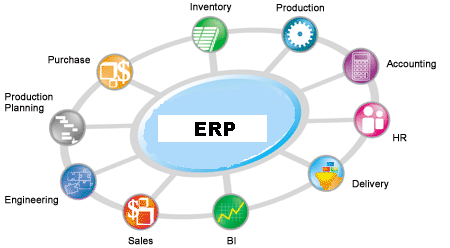
Nowadays, almost every organisation is using cutting edge ERP solutions to manage their business with ease.

Even, small businesses have started adopting custom made ERP solutions to handle their crucial business processes in a more professional manner.

As the government is making efforts to help UK SMEs expand and grow their businesses they will need the architecture to support such growth. Rather than having disparate systems integration will become key to increasing productivity and efficiency and creating true visibility across the organisation.

Small businesses constitute a major segment of overall business productivity. Adopting ERP is the best step that SMEs can take in order to increase their productivity and ROI. There are several operations at a small business enterprise that needs to be automated. In absence of proper ERP implementation, some of the key business operations like finance, inventory, human resource, purchase, or payroll need extra manpower and productive time.

SMEs are considered as major economic players and a potent source of national, regional and local economic growth (Taylor and Murphy 2004). Most small firms still under-utilise the potential value of IS innovations by only restricting them to administrative tasks Brock 2000). Enterprise systems (ES)provide Small to Medium-sized Enterprises(SMEs) with opportunities that are largely unexploited.

Women in the UK to receive equal pay deal in 2067


UK businesses are still more than five decades away from paying men and women equally. Though female salaries are on the rise at a rate slightly higher than those of men it is still going to be some

The 2010 National Management Salary Survey, conducted by the Chartered Management Institute (CMI) and XpertHR, shows that female salaries increased by 2.8 per cent over the last 12 months, compared to 2.3 per cent for men. However, with the average UK salary for a male manager currently £10,031 more than that of a female manager, women face a 57 year wait before their take-home pay is equal to that of their male colleagues.

Although this year marks the 40th anniversary of the 1970 Equal Pay Act, data collected from 43,312 individuals in 197 organisations reveals that male pay outstrips female pay by as much as 24 per cent at the most senior level.

Even at a junior level the gap still persists with male junior executives receiving £1,065 more than female executives. Across the regions, women in the Midlands fare the worst, taking home £10,434 less while those in the North East fare the best, where the gap is smallest at £8,955.

Looking at different industry sectors, female executives in the IT and pharmaceutical industry experience pay gaps that are higher than any other sectors, at £17,736 and £14,018 respectively.

CMI’s head of policy Petra Wilton says: ‘We want to see government take greater steps to enforce pay equality by monitoring organisations more closely and naming and shaming those who fail to pay male and female staff fairly.

Competitive businesses need to attract diverse workforces and appeal to the most talented employees. To do this managers and employers need to recruit from a wide talent pool but they cannot expect to attract the UK’s best female talent if they continue to undervalue it.”

Original Article: smallbusiness.co.uk

SAP expands university reach


As companies throughout the world continue to adopt on-demand technologies, universities and higher education institutions are finding it necessary to restructure their curriculum. In order to provide practical experience for students of business administration, SAP AG announced the start of a pilot project that incorporates the SAP ® Business ByDesign solution into the curriculum for universities taking part in the SAP® University Alliances program. This global initiative is offering selected university faculties access to SAP software and educational resources, and helping students gain practical skills in applying state-of-the-art enterprise software to real-world business scenarios. Instructors at 18 pilot universities in Germany, France, India, the United Kingdom and the United States now can supplement their curricula with innovative teaching methods and hands-on practice with business process modeling using the on-demand solution specifically developed for small businesses and midsize companies who want to work with an integrated, complete business application without the need to invest in IT infrastructure.

"Business graduates at the beginning of their careers typically lack practical experience and therefore have difficulty with business processes," said Helmut Krcmar, professor of Information Systems at the Technische Universitaet Muenchen (TUM)."

"By incorporating SAP Business ByDesign into their studies, our students can create their own company and design its business processes in a short time through the system's self-learning capabilities, enabling them to quickly see for themselves the inter-organizational relationships. This opens up entirely new teaching methods for us as, in the future, we can impart practical business knowledge by first using SAP Business ByDesign before we look closer at the theory."

"The on-demand solution from SAP simplifies the modeling of a business from the very beginning with a friendly user interface," said Daniel Pittel, business administration student at RheinMain University of Applied Sciences in Wiesbaden. "Even without technical skills and knowledge, you are led step by step through the business relationships. Right from the beginning of your studies you merge practice and theory, which clearly boosts successful learning and your motivation."

"Over 1000 colleges and schools use SAP software for education and research," said Oswald. "By including SAP Business ByDesign into our SAP University Alliances program with initially selected universities, we provide today's youth with the best foundation for a career in business administration. By transferring knowledge between technology and industry, we get feedback from different areas of expertise, which allows us to continue to optimize our offerings to the advantage of our customers."

Source: SAP AG

Follow a SAP Business One implementation and business transformation


A Boutique Bicycle Company, Torelli Bicycle, will be the first company to have their SAP Business One implementation and business transformation tracked and documented in the first of a series by Information Week.

The entire process – from planning and business process mapping, to go-live, to the company’s first experiences using its new software – is being documented by InformationWeek over the next few weeks as part of its "SMB Location Makeover" series, co-sponsored by SAP AG (NYSE: SAP). This implementation is being supported by SAP channel partner Navigator Business Solutions.

InformationWeek will follow the transformation at Torelli step by step via weekly updates, blogs, videos, interviews and feature stories. To help streamline business processes, pave the way for future growth, and help focus more on its core business and customers, the bike-maker is implementing the SAP® Business One application.

Torelli Bicycle, now entering its 30th year in business, runs a frame-building operation, in which it designs and builds custom road bikes and frames for professional racers and biking enthusiasts, as well as a parts and accessory business. The small shop of four full-time employees has experienced consistent growth, but its current computing systems and business processes were not keeping pace. The solution will help Torelli integrate its entire business across financials, sales, customer relationships, inventory and operations.

The InformationWeek documentation of Torelli Bicycle’s implementation is the first in a real-time, multimedia series that will showcase real-world technology deployments of enterprise resource planning (ERP) offerings to small and midsize businesses (SMBs). To follow in Torelli’s tracks as it plans, implements and runs SAP Business One, visit InformationWeek SMB On Location Makeover.

Source: SAP AG